Kenosha County held its top-tier AAA bond rating for a sixth consecutive year, and the reason is boring in the best possible way. Reserves were healthy and spending was planned instead of improvised.
Your driveway, patio and foundation respond to that exact same treatment. Concrete that gets inspected and sealed on a schedule stays inexpensive, while concrete that gets ignored eventually hands you a bill on its own timeline rather than yours.
What the County Actually Earned
In an announcement dated August 7, 2026, Kenosha County confirmed that S&P Global continued its AAA rating with a stable outlook. The agency pointed to healthy reserve funds, prudent financial management practices and continued strong economic growth trends in the area.
You can read the full announcement from Kenosha County for the details. The county is one of only seven in Wisconsin holding AAA status from a major rating agency.
County Board Chairman Mark Nordigian noted that the rating lets the county borrow for major projects at favorable interest rates, which saves taxpayer dollars. That is the part worth copying.
Good standing gets earned before the money is needed, not during the emergency. Homeowners who apply that idea to their hardscape spend far less over twenty years than neighbors who wait for a failure.
The Homeowner Version of a Strong Balance Sheet
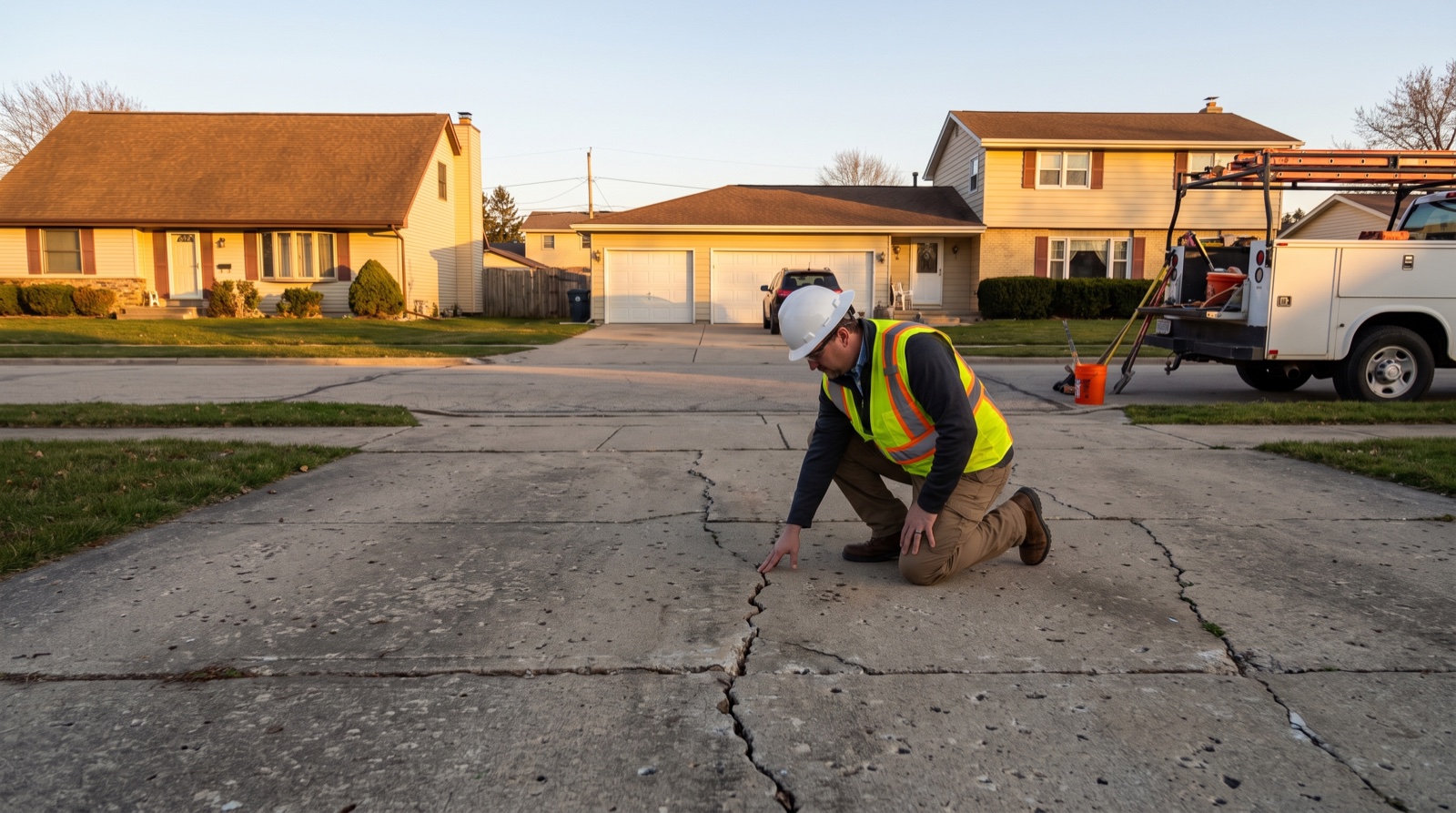
Most concrete work in Kenosha becomes urgent because nobody looked at it for six or seven years. By the time a slab is visibly failing, the cheap options have already expired.
A simple plan changes that. Walk your property twice a year, write down what changed since last time, and decide what gets addressed this season versus what gets watched.
Sealing, joint maintenance and small crack repair are the equivalent of a healthy reserve fund. They are low cost, they are predictable, and they buy you the right to choose when the bigger work happens.
Read the Signals Before They Force a Decision
Not every crack is an emergency and not every smooth surface is healthy. Here is how to sort what you see during a walkthrough.
| What you see | What it usually means | How soon to act |
|---|---|---|
| Hairline surface cracks, no height difference | Normal shrinkage or curing movement | Monitor and seal on schedule |
| Flaking or pitting on the surface | Freeze and thaw damage, often worsened by de-icing salt | Address within one season |
| One slab sitting lower than the next | Base washout or settlement underneath | Investigate this year |
| Wide crack with vertical displacement | Structural movement, not cosmetic | Get it evaluated now |
| Water pooling against the house | Slope failure directing runoff at the foundation | Get it evaluated now |
The first two rows belong in a maintenance budget. The last three belong in a project budget, and the difference between the two is usually a few years of attention.
Sequencing Work Around a Wisconsin Winter
Southeast Wisconsin gives concrete a hard time every year. Water gets into a crack, freezes, expands and widens the opening, then repeats the cycle through the entire cold season.
That physics is why late summer and early fall are the best window for corrective work in Kenosha, Pleasant Prairie and Somers. Fixing a quarter inch crack in September is straightforward, while the same crack in April has usually become something else.
A Practical Order of Operations
- Handle anything that moves water toward the house first, including grading, downspout runoff and low slabs near the foundation.
- Repair open cracks and failing joints next, before the first hard freeze arrives.
- Schedule full replacement of the worst surface for the following spring, once you know it cannot be saved.
- Leave cosmetic upgrades such as a new patio or decorative work for a season when nothing structural is competing for the budget.
Drainage always outranks appearance. A beautiful patio installed over a drainage problem is a short lived patio.
Where Repair Still Wins
Replacement is not the default answer. If the base underneath is sound and the damage is confined to the surface or to isolated joints, targeted repair work on existing slabs keeps far more money in your pocket.
Replacement earns its cost when the base has failed, when multiple sections have shifted independently, or when the slab is old enough that patching becomes an annual habit. At that point a new driveway pour stops the recurring spend.
The same test applies to the walkways and public sidewalk squares along your frontage, where uneven sections create a real trip hazard and a real liability. Small height differences can often be corrected without tearing out the whole run.
Anything touching your foundation and footings is a different category entirely. That work is not a maintenance item and should never be deferred to make a seasonal budget balance.
Start With an Honest Inspection
You cannot plan around a property you have not actually looked at. Spend twenty minutes walking your driveway, patio, walkways and the perimeter of your house, and photograph anything that looks different from last year.
If something on that list looks structural rather than cosmetic, get a second opinion before winter. We serve Kenosha, Pleasant Prairie, Somers, Bristol, Salem, Twin Lakes, Paddock Lake, Silver Lake and Trevor, and you can reach out for a written quote with no obligation attached.
The county did not earn a AAA rating by reacting to problems. Neither will your concrete.