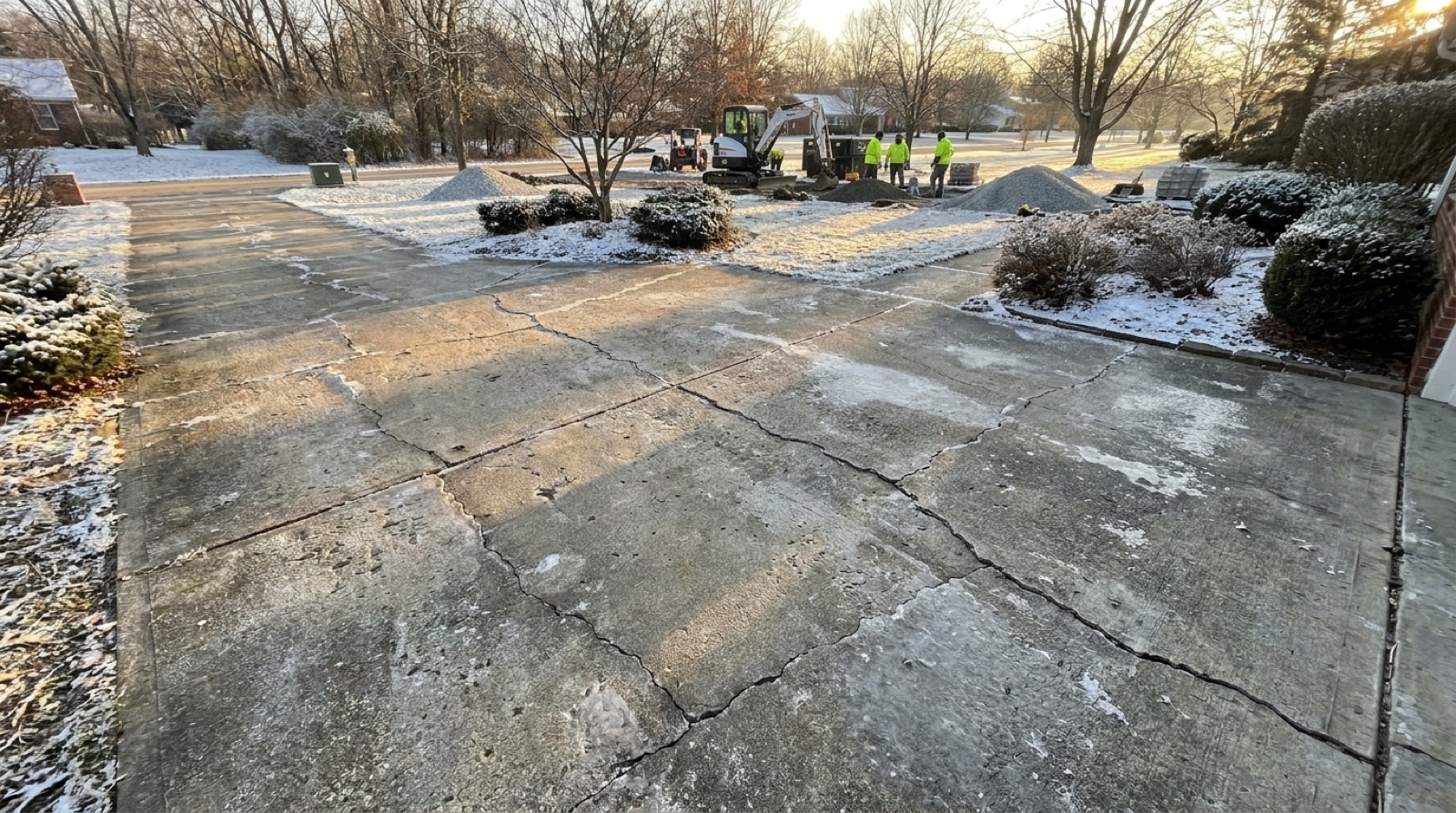
Concrete does not crack because it gets cold. It cracks because it gets cold, then warm, then cold again, over and over.
That distinction matters this year. Wisconsin Public Radio reported on July 14 that a developing super El Nino is expected to push Wisconsin toward a milder winter, with Amanda Latham of the Wisconsin State Climatology Office noting the state could see more wintry mixing, more icing, and potentially more rainy winter systems.
For anyone reading that as good news for their driveway, it is closer to the opposite.
Why Freeze and Thaw Is the Real Damage Mechanism
Concrete is porous. Water gets into it through the surface, through hairline cracks, and through joints.
When that trapped water freezes, it expands roughly nine percent. It has nowhere to go, so it pushes outward against the surrounding paste.
One freeze does very little. Forty of them in a season, with rain and melt refilling the pores between each one, is what lifts the surface off in flakes and turns a hairline crack into a structural one.
A hard, sustained January freeze is actually gentler in a strange way. The slab locks up in February and stays locked until spring.
A winter that hovers around 32 degrees and swings back and forth with every rainy system is the punishing version. That is the winter pattern El Nino tilts Wisconsin toward.
What This Looks Like on a Kenosha Property
- Scaling. The top layer flakes away and exposes the aggregate underneath. Most common on driveways and south facing walks that thaw in the afternoon sun.
- Spalling. Chunks pop out, usually near edges and joints where water collects.
- Joint widening. Control joints open up, take on more water, and accelerate everything else.
- Slab movement. Saturated soil under a slab heaves unevenly and leaves you with a lip at a seam.
Kenosha Has a Second Problem: The Lake
Lake Michigan keeps the lakefront side of Kenosha and Racine a few degrees off from what inland Kenosha County sees. In a normal winter that moderating effect is mostly a nuisance for snow totals.
In a mild winter it means the eastern edge of the county spends even more hours parked right around the freezing point. More hours at 32 degrees means more crossings of the freeze line, and crossings are what count.
Properties in Pleasant Prairie and out toward the western part of the county are not exempt. They just tend to run a slightly different cycle count.
Deicing Salt Makes It Worse, Not Better
Rock salt does not attack concrete chemically in the way people usually assume. It causes damage by keeping water liquid at lower temperatures, which means more melting, more absorption, and then a harder refreeze when the temperature finally drops.
An icy El Nino winter means more people reaching for the salt bag more often. If your slab is already scaled or cracked, that combination will take a bad surface and finish it.
Concrete poured in the last twelve months is the most vulnerable of all. New work should get through one winter before it sees any deicer.
What Is Worth Doing Before Fall
The useful window is now through roughly early October. Pouring and sealing both need reliable temperatures, and Kenosha does not offer many of those after Halloween.
| Condition | Action | Timing |
|---|---|---|
| Hairline cracks under 1/4 inch | Seal and monitor | Late summer |
| Open cracks, minor scaling | Repair and reseal | Before October |
| Heavy spalling, exposed aggregate | Replace the section | Schedule now |
| Slab lifted or sunk at a seam | Investigate the base first | Before ground freezes |
Sealing is the cheapest thing on that list and the one most people skip. A penetrating sealer applied to sound concrete cuts water absorption sharply, which is the entire ballgame in a thaw heavy winter.
It is not a fix for damaged concrete, though. Sealing over a scaled surface traps the problem instead of solving it, so damaged sections need to be repaired before anything goes on top.
When Repair Stops Making Sense
There is a point where patching a slab costs more over five years than replacing it once. Broadly, if more than about a third of the surface is compromised, or if the cracking traces back to a failing base rather than the surface, replacement is the honest answer.
That usually means taking the old slab out and correcting the drainage or base problem that caused the failure. Otherwise the new pour inherits the same fate.
A properly built driveway with an air entrained mix, a compacted base, and correctly spaced control joints handles Wisconsin winters for decades. The slabs that fail early are almost always the ones that were poured thin, over poor base, or without joints in the right places.
The Areas That Fail First
Driveway aprons take the most abuse because they collect street runoff and street salt. Walkways come second, since they get the heaviest deicer application per square foot.
Patios usually last longer, but a stamped or decorative surface shows scaling far more obviously than a broom finish does. The pattern loses definition before the slab loses strength.
If your front walk already has flaking or a lifted seam, this is the year to deal with it rather than the year to wait.
Getting Ahead of It
El Nino tilts the odds toward a mild winter. It does not guarantee one, and Wisconsin can still deliver a brutal cold snap regardless of what the Pacific is doing.
But the work that protects concrete against a thaw heavy winter is the same work that protects it against a cold one. Sealing sound slabs, repairing open cracks, and replacing surfaces that are past saving are all worth doing either way.
If you want an honest read on which category your concrete falls into, get in touch for a quote before the fall schedule fills up. Call (262) 667-5367 if you would rather talk it through.