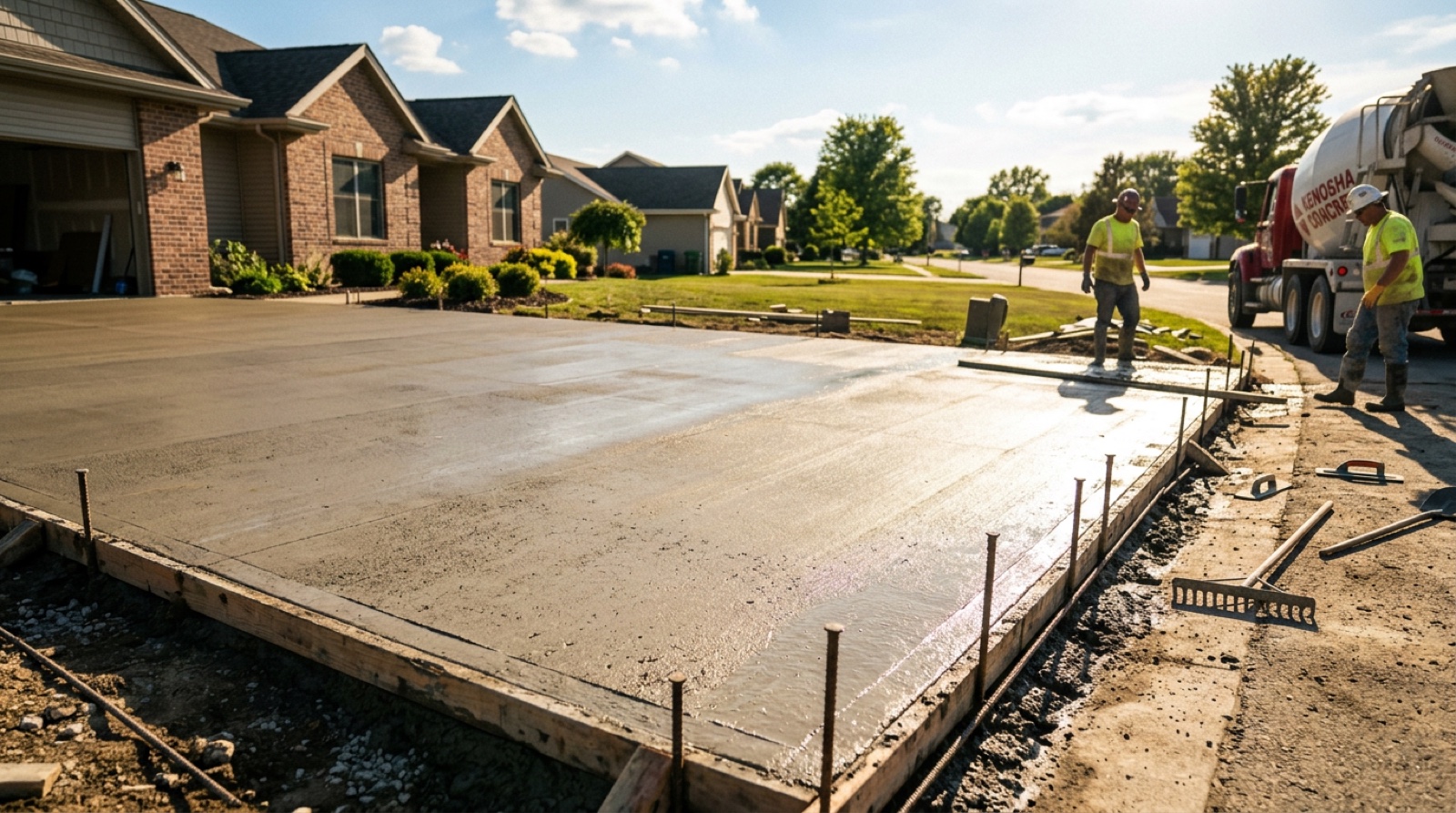
A week that pairs a 100-degree heat index with overnight thunderstorms is the hardest week of the year to place concrete in Kenosha County. Fresh slabs lose water too fast in the afternoon, then get hit with rain before the surface is strong enough to shrug it off.
If you had a slab poured in the last ten days, the next month is when problems show up. If you are planning work, the smart move is scheduling around the weather rather than through it.
What Actually Happened Here in Late July
Kenosha, Racine and Milwaukee counties sat under a heat advisory on Sunday, July 26, with heat index values forecast to reach 100 to 103 degrees. Counties just west of us were placed under an Extreme Heat Warning as index values climbed toward 105.
The storms came with it. Forecasters warned of damaging wind gusts up to 70 mph, large hail and isolated embedded tornadoes overnight, with temperatures finally dropping back into the mid 80s by Tuesday. You can read the Milwaukee Journal Sentinel forecast coverage for the full detail.
That is the worst possible combination for wet concrete. Extreme drying conditions during placement, then water landing on a surface that has barely set.
Why Heat Ruins a Slab Before You Ever See It
Concrete does not dry. It cures through a chemical reaction that needs water to stay in the mix for days.
When the air is 95 degrees, the sun is direct and there is a breeze off the lake, the surface loses moisture faster than water can rise from below. The top skin shrinks while the concrete underneath does not, and it tears.
The Specific Failures and How Crews Prevent Them
| Hot weather problem | What you eventually see | How it gets prevented |
|---|---|---|
| Rapid surface evaporation | Random hairline cracks in the first day or two | Fog spraying, evaporation retarder, wind screens |
| Shortened working time | Cold joints and a blotchy, uneven finish | Dawn start times, retarding admixture, extra finishers on site |
| Dry, hot subgrade and forms | Weak bottom of slab, early edge failure | Dampening the base and forms before the truck arrives |
| Rain on green concrete | Pitted, dusty, chalky surface that sheds sand | Sheeting kept on the trailer, or the pour is postponed |
| Heavy runoff behind walls | Washed out backfill, leaning or bulging block | Drainage stone, weep holes, filter fabric |
None of this is exotic. It is the difference between a crew that watches the forecast and one that just shows up with a truck.
Decorative Work Is the Least Forgiving
Broom finished flatwork gives you a little slack. Decorative work gives you almost none.
Stamping needs the slab in a narrow window of firmness. At 95 degrees that window can close in under an hour, which is why stamped and patterned finishes in a Wisconsin July often need a larger crew and a much earlier start than the same job in September.
Integral color and release agents behave differently in heat too. Uneven curing shows up as light and dark patches you cannot wash off, which is a permanent problem on a backyard patio you look at every day.
What to Check on Existing Concrete This Week
Heat and storm cycles stress concrete you already own, not just new pours. Walk your property and look at four things.
- Joint sealant. Sun cooks caulk and expansion joint filler until it shrinks and pulls away. Open joints let storm water straight down to the base.
- Slab edges near downspouts. Heavy rain from a 70 mph storm line moves a lot of water in minutes. Look for washed out gravel and voids under the slab edge.
- Cracks that changed width. A crack that was hairline in May and is now a quarter inch wide is telling you the base is moving.
- Grading against the house. Concrete that has settled toward the foundation sends every storm to your basement wall.
Small problems caught now stay small. A sealed crack costs a fraction of the repair work needed once water has undermined the base through two or three freeze cycles.
When Repair Stops Making Sense
Once a driveway has multiple cracks wider than a quarter inch, sections that rock under a car tire, or spalling across more than a third of the surface, patching is throwing money at it. At that point a full replacement is the cheaper number over ten years.
Same logic applies to a wall. A block or poured retaining wall that leans after a storm has a drainage failure behind it, and no amount of surface work fixes that.
The Best Pour Window in Kenosha Is Coming
Late August through October is the sweet spot in southeast Wisconsin. Air temperatures in the 70s, cooler nights, lower evaporation rates and enough time before the first hard freeze for the slab to gain real strength.
That window fills up. Homeowners in Pleasant Prairie, Somers, Bristol, Salem, Twin Lakes, Paddock Lake, Silver Lake and Trevor all want the same six weeks, and the crews book out.
If you are weighing a driveway, patio, walkway or wall for this fall, now is the time to get it measured and scheduled. Reach out for a quote or call (262) 667-5367 and we will get you on the calendar before the good weather runs out.